




Hiking the Tour du Mont-Blanc with children is entirely possible, provided you rethink the stage breakdown, accept using valley transport and aim for enjoyment rather than performance.
From what age ?
There's no universal age for taking on the Tour du Mont-Blanc as a family. It all depends on the child: their experience, their stamina, their motivation and the way you split the route. For a full TMB where the child walks every stage, somewhere around 10 to 12 years old can be realistic, provided they already have genuine hiking experience.
A child used to walking in the mountains, carrying a small pack, managing tiredness and sleeping away from home will be far more comfortable than an older child with little experience of sustained effort. Prior experience counts just as much as age.
For younger children, a partial TMB is often the better idea: a few chosen stages, an adapted loop, or a stay based around certain refuges. It's a way of discovering the spirit of the Tour without imposing too long a trek.
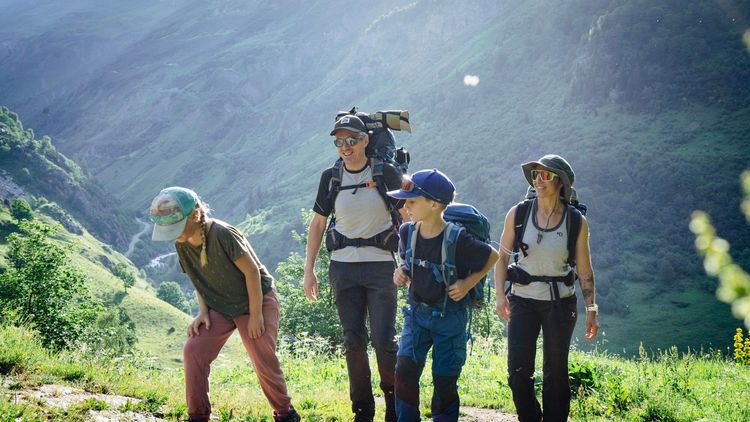
A family TMB isn't prepared like a TMB between fit adults. The pace needs to be looser, the stages shorter, the refuges carefully chosen and the breaks more frequent. The aim isn't only to reach the end, but to create a positive experience for everyone in the family.
For hiking with children, the French hiking federation recommends regular breaks of around 10 to 15 minutes every hour, and paying attention to each person's needs. That approach matters all the more on a multi-day trek like the TMB.
How many days to plan for as a family ?
For a family Tour du Mont-Blanc, splitting the route over 11 or 12 days is generally the best fit. It shortens each stage, makes room for more breaks and leaves a margin in case of tiredness, difficult weather or a small hitch along the way.
Shorter stages change everything. They mean arriving at the refuge with energy left, enjoying the place, playing outside, having a shower, eating without rushing and sleeping well. For children, the quality of the evening counts as much as the day's walking.
Avoid stringing together overly ambitious days. A long stage might go fine once, but it can also take a serious toll on motivation for the days that follow. With a family, the right pace is the one that has everyone setting off again the next morning wanting to.
Choosing the right refuges
The choice of refuges is essential to a successful family TMB. Not every place meets the same needs. Where possible, go for private rooms or small dormitories. Sleep is a key factor, particularly for children.
Refuges with outdoor space are also very welcome. After several hours of walking, children often need to move differently, to play or simply to sit outside. A terrace, a meadow or a quiet spot can make arriving much more pleasant.
Check the showers, the meals, the timings and whether portions can be adapted. Simple menus are usually more reassuring for children. If your child has specific dietary requirements, contact the refuges before you leave.
Finally, think about the atmosphere. A welcoming, family-friendly refuge with a team used to children can transform a stage. The TMB is a human adventure too: the connection with the wardens, the other hikers and the families you meet is part of what stays with you.
Managing morale and motivation
On a family trek, morale counts as much as legs. A child can walk for a long time if they understand the goal, feel valued and find some enjoyment along the way. Conversely, a day that's too long, too monotonous or too constrained can quickly turn hard.
Set the pace by the slowest child. They aren't "slowing the group down": they're setting the right tempo so the experience stays a shared one. Take regular breaks, offer small intermediate goals and acknowledge every effort.
Motivation also comes from looking around. Spotting marmots, identifying flowers, picking out a col, following the map, counting the refuges, watching the glaciers: small missions that turn a walk into an adventure.
Be ready to fall back on other options. Taking a bus, shortening a stage, skipping a difficult variant or stopping earlier isn't a failure. It's often what preserves the enjoyment and stops the mountains becoming something to dread.
Specific equipment for children
A child shouldn't carry too heavy a pack. Theirs should stay light: water, snacks, waterproof jacket, cap, a light fleece, and maybe a notebook or a pair of binoculars. The heavy items belong in the adults' packs, or with a baggage transfer service if you go for that option.
Footwear needs to be taken as seriously as for adults: comfortable, already worn in, suited to the terrain and protective enough. Blisters on a child can compromise the rest of the trek.
For clothing, apply the three-layer system here too. Children can get cold quickly during breaks or at the top of a col. Always keep a warm layer and a rain jacket within reach.
What if you don't do the full Tour?
Doing the TMB as a family doesn't have to mean completing the whole loop. A partial itinerary can make an excellent first experience. A few well-chosen stages, with good refuges and a suitable pace, will often leave a better memory than a full Tour done in a state of exhaustion.
You could also picture a TMB in instalments: one section one year, another the year after. That way, children grow alongside the project and get more out of each section.
The main thing is to hold on to the sense of adventure. The Tour du Mont-Blanc isn't an exam. It's a mountain experience to share, with its surprises, its adjustments and its high points.

Check availability in real time
See the beds remaining in the refuges and guesthouses of the Tour du Mont-Blanc and book your stages on the official website.