




The Tour du Mont-Blanc is not technical, but it does require you to string together days of ascent. Three months of steady preparation is enough to turn the trek into a pleasure rather than a trial. Here is a simple plan, week by week.
What fitness do you really need?
The requirement is simple: being able to walk for 6 hours with 1,000 m of ascent, with a pack on your back, and to put your boots back on the next day. There is no climbing and no technical equipment involved, but you do need endurance and consistency.
If you are going for 10 or 12 days, the bar is lower: stages come to around 4 to 6 hours of walking.
The 90-day plan
- Day -90 to day -60: two outings a week, one of them uphill. Aim for 2 to 3 hours of walking, without pushing.
- Day -60 to day -30: one long weekly outing of 4 to 5 hours with 800 to 1,000 m of ascent, carrying a 6 kg pack.
- Day -30 to day -10: a « test » weekend of two consecutive days with the actual pack and the boots you will trek in. This is when you discover the rubbing points and the adjustments to make.
- Day -10 to day 0: reduce the volume, look after your sleep, and stop testing anything new.
D-90: building the foundations
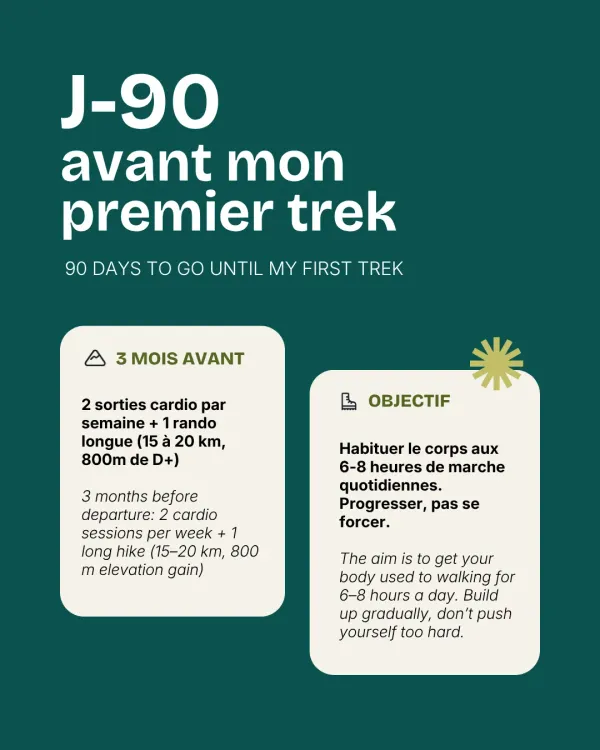
Three months before departure, the goal is to build your basic endurance. This is not yet the time for very long hikes, but rather to establish a consistent training routine. Your body needs to become accustomed to physical effort, long periods of walking and strength training.
A good foundation can consist of two cardio sessions per week, one hiking session at the weekend and one short strength-training session. Cardio can take many forms: brisk walking, cycling, swimming, light running, stair climbing or using an elliptical trainer. The important thing is to maintain a moderate level of effort for 45 minutes to 1 hour.
Your hiking sessions should gradually include more elevation gain. Start with 2 to 3 hours of hiking, then gradually increase the duration. At this stage, your backpack can remain light, but it is worth starting to hike with the model you will use on the TMB to check that it is comfortable.
Strength training should target your legs, back and stability. Squats, lunges, step-ups, core exercises and balance exercises are particularly useful. The descents on the TMB put considerable strain on the quadriceps and knees, so it is better to prepare them beforehand.
D-60: increasing the training load
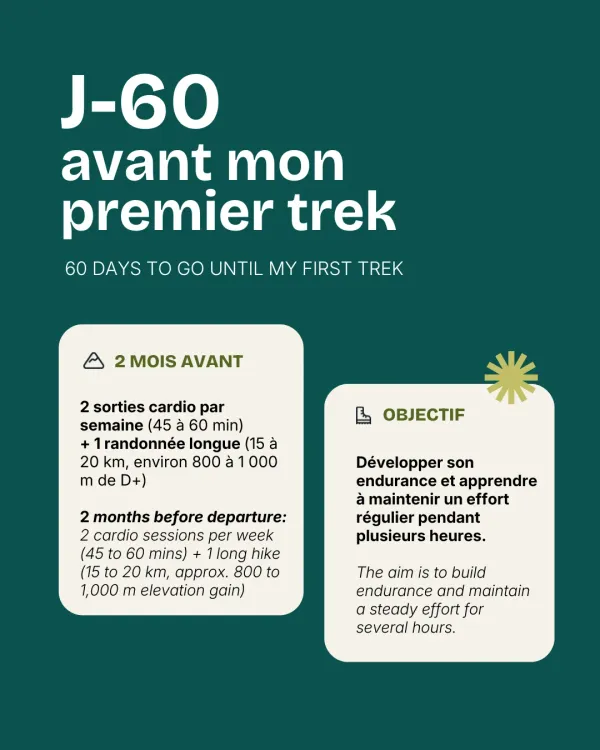
Two months before departure, your preparation becomes more specific. The aim is to gradually increase your training volume without making any sudden changes. This is the time to complete longer hikes with more elevation gain and to start carrying a backpack close to its actual trekking weight.
Once a week, plan a 4 to 6-hour hike with 700 to 1,000 m of positive elevation gain if possible. Gradually add weight to your backpack until you reach the load you expect to carry on the trek. The FFRandonnée points out that backpack weight should be carefully managed on long-distance hikes and recommends keeping it below approximately 20% of the hiker's body weight.
At D-60, it is also very useful to test two consecutive days of hiking. This is often when the real weak points become apparent: shoes that cause rubbing, a poorly adjusted backpack, knee pain or insufficient recovery. It is better to identify these problems now than during the second stage of the TMB.
You should also work on your descents. Many hikers train for the climbs but underestimate long descents, which can be particularly demanding on the joints. If you have access to steep trails, gradually incorporate them into your training.
D-30: fine-tuning and testing
One month before departure, the goal is to validate your preparation. Ideally, complete a realistic 2 or 3-day test hike using exactly the equipment you intend to take: backpack, shoes, socks, clothing, trekking poles, hydration system and first-aid kit.
This test should answer several questions: are your shoes sufficiently broken in? Is your backpack too heavy? Can your shoulders and hips comfortably handle carrying it? Do your clothes perform well in rain or cooler conditions? Can you maintain your pace for several consecutive days?
Use these full-scale training hikes to test your navigation skills, practise reading an IGN map and make sure you know how to use a GPS and an offline mapping app.
During the final ten days before departure, the goal is no longer to improve your fitness but to recover. Reduce your training load, get enough sleep, stay well hydrated and avoid demanding hikes that could cause an injury. You cannot build your fitness in a week, but you can easily compromise your departure by overtraining.
The classic mistakes
The first mistake is thinking that “walking a little” is enough. The TMB is accessible, but it remains demanding. You need to prepare your body for repeated physical effort.
The second mistake is setting off with brand-new equipment. Shoes that have not been broken in, a backpack that has never been tested or unsuitable socks can turn a great adventure into an ordeal. Test everything beforehand.
The third mistake is carrying too much weight. Every kilogram matters, especially during long climbs and descents. A carefully planned, lightweight and well-organised backpack will directly improve your hiking comfort.
Finally, do not neglect recovery. Sleep, nutrition and breaks are all part of your preparation. A well-prepared hiker is not simply someone who can walk fast, but someone who can keep going.

Ready to build your Tour du Mont-Blanc?
Move from theory to practice: discover the full route, the refuges and the tools to organise your trek stage by stage.